Summer officially arrived this week. The solstice has just passed. The days are still long, but now, just by moments a day, they are becoming shorter again.
A few weeks ago I wrote that spring eventually stops asking ‘what am I going to do?’ and begins asking ‘how am I going to tend to what I've already chosen?’ Well, we have arrived there, or at least we are getting really close!
Summer planting is done or well on its way to completion. Returning perennials are stretching toward one another and learning to play with new additions, the annuals plantings are beginning to reveal their intent in earnest. Containers are filling in, and seedlings are getting rooted and established. The work of transition from spring to summer is giving way to something different.
A new rhythm in the garden about to begin.
Tick. Tock.
Not because there is suddenly too much to do, there is ALWAYS too much to do. But now timing has become one of our most valuable tools.
For much of the spring, gardening is driven by decisions. What should be planted? What should be divided? What should be cut back? What should be removed or rearranged? Every walk through the garden seems to reveal another possibility, another project, another beginning.
The onset of summer changes the question.
By now, most of the decisions have mostly been made and the work turns toward management, maintenance, and stewardship. It is all about how to complete and keep up with what we have already begun.
Spring is generous with time and second chances. Summer is less forgiving. If the first round of zinnia seeds didn't quite take there has been time for another try. Nurseries have been stocked every week with new materials flying off the racks. Tiny weeds have been practically imperceptible, and the lawns have been that lush green that make you want to throw out a picnic blanket. Garden pests have been just barely emerging and hardly a concern.
A week can make a remarkable difference now.
In the summer you turn your back for a second and everything has changed. Suddenly infestations arise - aphids, spider mites, and scale - oh my! Lawns punk out in the humid developing fungal brow patches. Growers are sending out less and nurseries stocking less as both know that soon the weekend warriors will be headed to the beach and no one wants to get stuck with inventory. Time for 'grown from seed' and 'herb a vegetable' is about to close. The once imperceptible weeds are roaring forth, a sneaky bind weed already halfway up the tree.
The work itself hasn't changed nearly as much as the timing has.
At first glance, summer feels urgent.
Get the last of planting done, deal with treatments and pruning a and lawn cutting. Tune in to the changing needs for watering with the heat and drought that often accompanies the change of season. New demands feel pressing, but I think urgency has a bad reputation and sometime gets confused with rushing.
Gardening teaches a different kind of urgency. Summer’s urgency is not about doing everything today. It is about doing the right thing today.
New gardeners often think ‘knowing the right thing’ means learning more plants or mastering more techniques. Those things certainly help. But over time, I have come to believe experience has as much to do with developing a keen sense of timing as it does with developing knowledge. Knowing what matters now, what can wait until next week, what should have been done yesterday, and what it is time to abandon for this season
So , I thought I would share in TWIG what WE are doing now – this week, as we feel the tick tock of the clock to get the right things done at the right time and right on time!
We are definitely scrambling to finish any summer plantings.
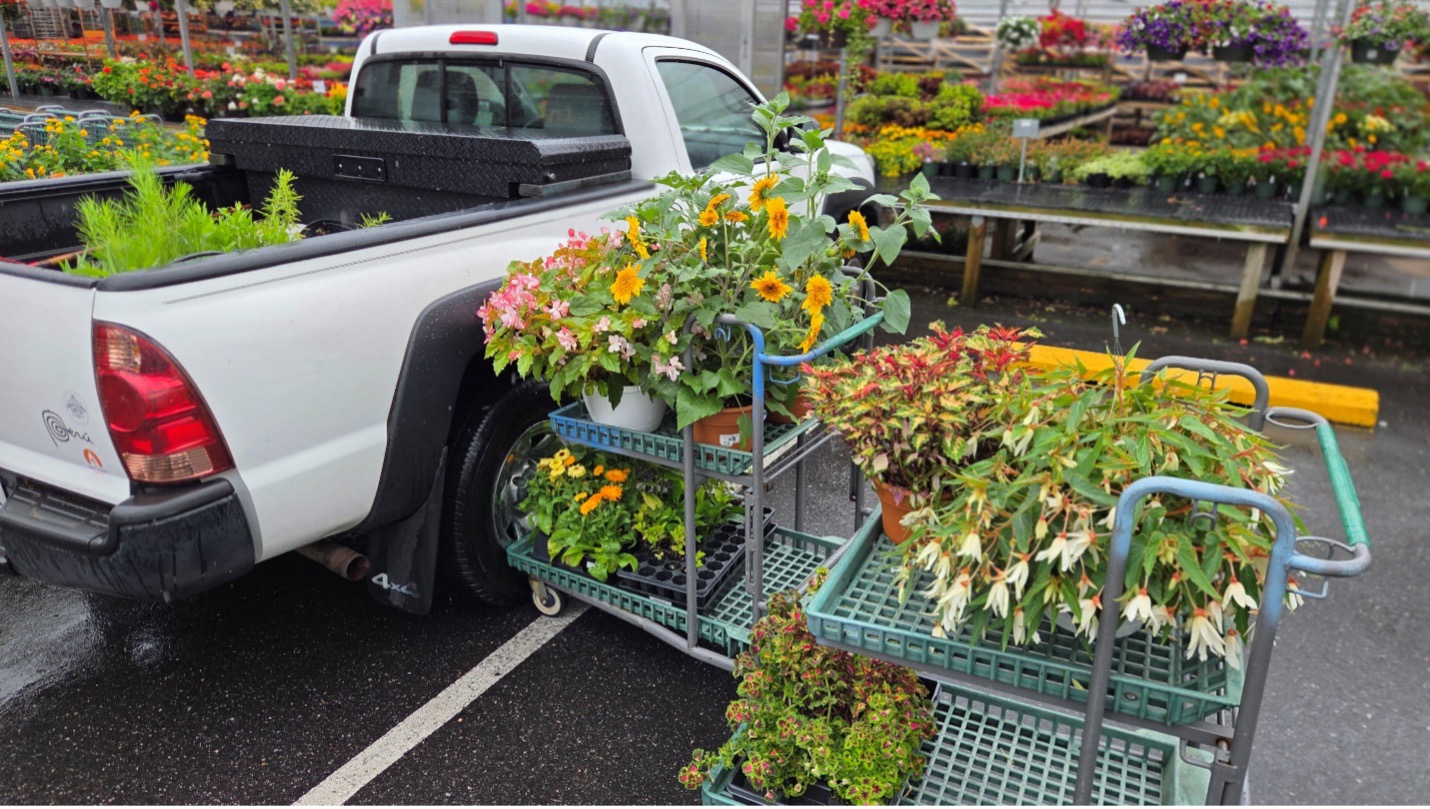
Annuals (particularly nursery raised) do appreciate a bit of easier season time to get going. Most have been grower coddled to be their best for delivery to nurseries and garden centers and dropping them in the ‘real outdoors’ is a big change. Additionally, the pickings are getting slim as the big purchasing season is wrapping up. Neither growers or nurseries want to end up with wasted inventory, so it is time to get ‘em while you can! Any seedling annuals that you are growing also better be getting in the ground but fast. Whether direct seed or tray grown, these tender babies want to have their roots well in the ground as summer heat arrives.
Perennial planting is a little more forgiving, but it is time to start to wrap that up too, mostly so they can ‘collaborate’ with all the players already in the border. With all your work to pinch and prune and ‘Chelsea chop’ the perennial garden is staged for success. New additions can come in at a nice scale now and grow right in the crowd – look for space and ‘shopportunities’
Trees and shrubs are the most tolerant of summer planting but mind your schedule. Anything planted now will need careful attending and thoughtful, conscientious watering. Off to the beach in the next 2 weeks? You better drop it until mid September!
We are watching closely for pests, weeds and need for treatment.
Things move fast in the summer heat! Insects and scale can increase exponentially in the bat of an eye. Weeds find their way, suddenly elbowing in among the annuals inhibiting growth, disguising themselves tangling among the tall perennials, or scrambling up tree trunks and vining into the crown of shrubs with shocking speed. It is time to be ready with all appropriate measures. Not sure what is ‘appropriate’? bring it to ‘Office Hours’!
And a reminder about weeding, for everyone with developed perennial gardens. Not every little green seedling is a weed. We are seeing the first signs of baby foxglove, forget me not , viola etc. among the chickweed and crabgrass and (arguably a weed / maybe a salad) purslane. Slow down while you are weeding and make sure you are not pulling out your valuable seeding annuals and biennials!
We are attending to watering routines.
Firstly, and most importantly, we are observing what needs what and paying attention to where in the gardens we need to make adjustments. We are watching the weather and forecasts and rain gages closely – rain ‘here’ does not necessarily mean rain ‘there’ and measurable precipitation is more accurate than ‘I think I saw it raining’. Whether making season adjustments to the elaborate control boxes of watering systems, or adding mechanical timers our simple DIY ones, it is time to up the attention. We are making mental notes as to who needs special attention if newly planted or out of the range of systems, and ordering equipment - nozzles and sprinkler heads and watering cans - for places where we don’t have the luxury of systems and need to drag hose. Finally, we are checking in with clients and working among ourselves on our team to get some idea of who is going to be on summer travel when. All working to make sure make sure we have ‘watering coverage’ across the board.
Treatments
This starts to get into a sort of esoteric and controversial territory. Of what works and what doesn’t and what’s worth doing and what to let go. There is science and practice and lore around all of it and every gardener has their own ways. I think of it a little like the cosmetics/spa industry. You can choose to use creams and toners and all kinds of treatments. Some work, so don’t. Some are minimally invasive and routine, so are a major undertaking. We can talk about it a lot, I’m just going to share what we are doing this week.
I’m spraying lots of things – mostly deciduous trees and shrubs, but also kind of everything - with a light light coating of horticultural oil. The lightest mix rate recommended and maybe even a little less, to inhibit infestations and fungus on leaves. I sometimes mix in a bit of liquid seaweed, foliar micronutrients (?). A lot of gardeners tell me it is useless nonsense, but I think I can observe benefits, so I do it (even though is a little funky smelly). I call it my Japanese salad dressing mix. I do avoid needled evergreens with this stuff.
I’m putting some granular fungicide down on the lawns, and maybe just a little light hit of fertilizer if the grass is looking hungry. Keeping lawns going in the hot, humid summers in our region is hard – practically impossible in the city with inhibited air flow. Higher nighttime temps increase fungal activity, and lawns tend to brown out at this time of year. Does fungicide help? Sometimes, maybe. You know what really helps? Managing expectations! Beautiful green lawns are for spring and autumn… oh and for golf courses where all focus is on the grass and the treatment regime is super model level.
Weed control
Yes, I’m bringing it. The use of weed killers – whether broad ore specific, for through lawns, in the tiny cracks of sidewalks, or in the industrial agricultural world, is super controversial. I’m not going to get into it. I AM talking about what we are doing this week, and yes, we are using a bit of Roundup (glyphosate) to control weeds. I usually buy a bottle of concentrate at the hardware store at this time of year, we use it judicially and carefully, in pavers and open spaces away from anything we want to grow. Once or twice during a season for management really helps and if you have ever had to weed over a brick or paver patio or sidewalk, spending not getting out roots and coming back 10 days later to do it again, you’ll understand why sometimes it is time to reach for the tank sprayer. All that said, I do ask for consent when using in client gardens first. And no means no.
Staking
This is JUST starting, but tall perennials, tomatoes, dahlias etc. benefit from having structures getting in place now. This week we are ‘unstaking’ the peonies and moving their stakes to their next duty. If you are particularly crafty you can even ‘spool up’ the string you used to reuse for the next projects.
Setting appointments with arborist
If you have significant trees, summer is a good time to have a look around with your arborist. I’m trying to get appointments set now because, like everyone else, even arborists go on summer vacation and as the pace changes in the summer’s garden schedule, I have some extra time to meet too.
All this in summer's service to the gardens - in the name of stewardship. Stewardship is an interesting word. It isn't ownership. It isn't control. It is simply accepting responsibility for something that has been placed in our care. And hitting the marks to make sure it gets done.
Knowing how and when to provide this care is where experience quietly reveals itself. In developing the ability to pay attention to the ‘tick tock’ of the seasonal change and knowing how to manage it.
All these summer projects seem like a lot to do, but the days are still long and there are weeks and weeks ahead. Experienced gardeners aren't usually the ones working the fastest, nor are they necessarily working the hardest. They learn that urgency is not about moving faster. It is about recognizing the right thing at the right time, and identifying the precise moment when one task has become the task for the time.
Perhaps that is what experience really looks like. Not greater effort. Better timing.
The calendar matters.
The weather matters.
Yesterday matters.
Tomorrow matters.
But mostly, this morning matters.
The garden is always asking the one urgent question - What is the right thing, right now?
The tick tock of time is simply the medium through which attention operates. The season keeps moving. Our task is simply to keep paying attention. Gardening teaches a different kind of urgency. Summer's urgency is not about doing everything today. It is about doing the right thing today.
New gardeners often think "knowing the right thing" means learning more plants or mastering more techniques. Those things certainly help. But over time, I have come to believe experience has as much to do with developing a keen sense of timing as it does with developing knowledge. Knowing what matters now, what can wait until next week, what should have been done yesterday, and what it is time to abandon for this season.
So I thought I would simply share what WE are doing in our gardens this week.
If timing is what experience looks like, then this is what timing looks like in late June...