This week in gardening, we are thinking a lot about time.
Someone asked me this week, ‘Aren’t those tulips blooming early?’. My first response was yes — they are an early blooming species, and with some unseasonably warm weather they have kicked off a bit ahead of what I had expected.
But then I corrected myself.
They are not blooming ‘early’. They are blooming right on time — their own time. The garden’s time.
Seasons can be surprising and unpredictable. Weather patterns shift. Temperatures swing. A warm spell can speed things up, and a cold one can hold them back. One of the useful reminders the garden offers us every year is that our human schedule and the garden’s schedule are not always — in fact, rarely — the same thing.
The garden is not late. It is not early. It is in motion.
Paying attention matters. Noticing what is happening now — rather than what we think should be happening — is one of the most valuable habits a gardener can develop.
At this time of spring, there is so much going on, and it is happening fast. Spring bulbs and flowering trees are in bloom — thrilling. Perennials are emerging and begging not to be stepped on. Roses are ready for pruning, hydrangeas want deadwooding. Lawns need their first cuts and spring fertilizing. And let’s not even talk about weeds.
Even with the garden in full spring flush, it is easy to start feeling overwhelmed by all that is about to happen.
This week, we are assessing all of that — what is happening now, and what is about to be ‘on fire’ first. We are positioning ourselves for the work that is coming. But I am encouraging everyone — myself included — to also take some time simply to enjoy the garden.
These are the weeks we’ve been working toward even since the autumn. Now go on and take a moment to reset yourself on garden time.
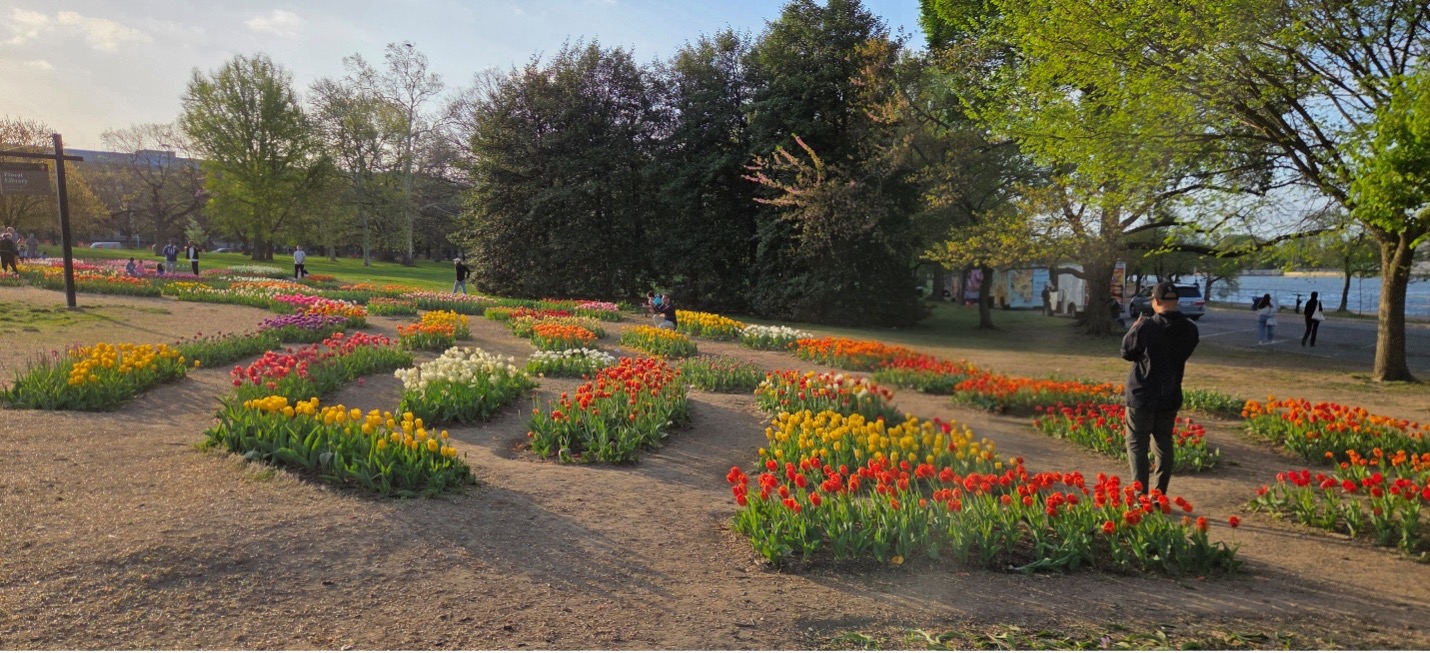
I try to make the space every year for at least one visit to The Floral Library” on the National Mall near the Tidal Basin (the photo above).
Established in 1969 as part of First Lady Lady Bird Johnson’s Capital Beautification Project, the garden was conceived around the idea of putting “masses of flowers where masses pass.” (I copied this from the National Park Service website). With 93 individual beds of tulips in the spring, it is a wonderful place to make a few notes about what I might include in next year’s bulb order — and to watch all kinds of people from all over the world swoon over the display.
There is a lot of useful information in this kind of practice — observing, enjoying, and assessing all at once. What has been successful? Am I happy with the season’s tulip palette? How did the hard winter affect the broadleaf evergreens — and do I need to do anything about it? Is it time to check in with the arborist?
Make a list. Then set it down. And allow yourself a little time to drift in the spring garden.
Gardening often asks us to work with time in a way that much of the rest of the world does not. Not efficiently, exactly. Not on demand. But in season, in sequence, and in relationship.
And perhaps that is one of its quiet gifts.
—
As always, I’d love to hear what you are noticing in your own garden. What feels “early” right now — and what, upon closer inspection, is simply right on time?