WATERING
In this middle week of April here in Washington, D.C., we had a bit of a heat wave. The last days have been hot and windy—and that combination will likely bring a quick close to the spring flowering bulb season.
Meanwhile, things are growing like mad—or trying to—in these lengthening days of light and warm weather.
It is time to start paying attention to watering.
“How much should I water?” is one of the more challenging questions I am asked. I try to evade it as best I can, usually saying—you should water as much as you need to.
There are, unfortunately, no rote answers to this question and no easy measures. I could say, every third day, unless it rains—but then, what is considered sufficient rainfall to skip a watering? And how do you measure—by time, by volume? These are not easy marks to hit.
For this bulletin, I’ll be talking about watering, with the hope of opening a discussion in The Gardeners Stream about how, when, and with what.
Watering Systems
If you are fortunate enough to have a professionally installed watering system—good for you.
These systems can be really effective for keeping up with watering in larger gardens, or for people who travel, or simply don’t have the time or inclination to drag hoses and watering cans around.
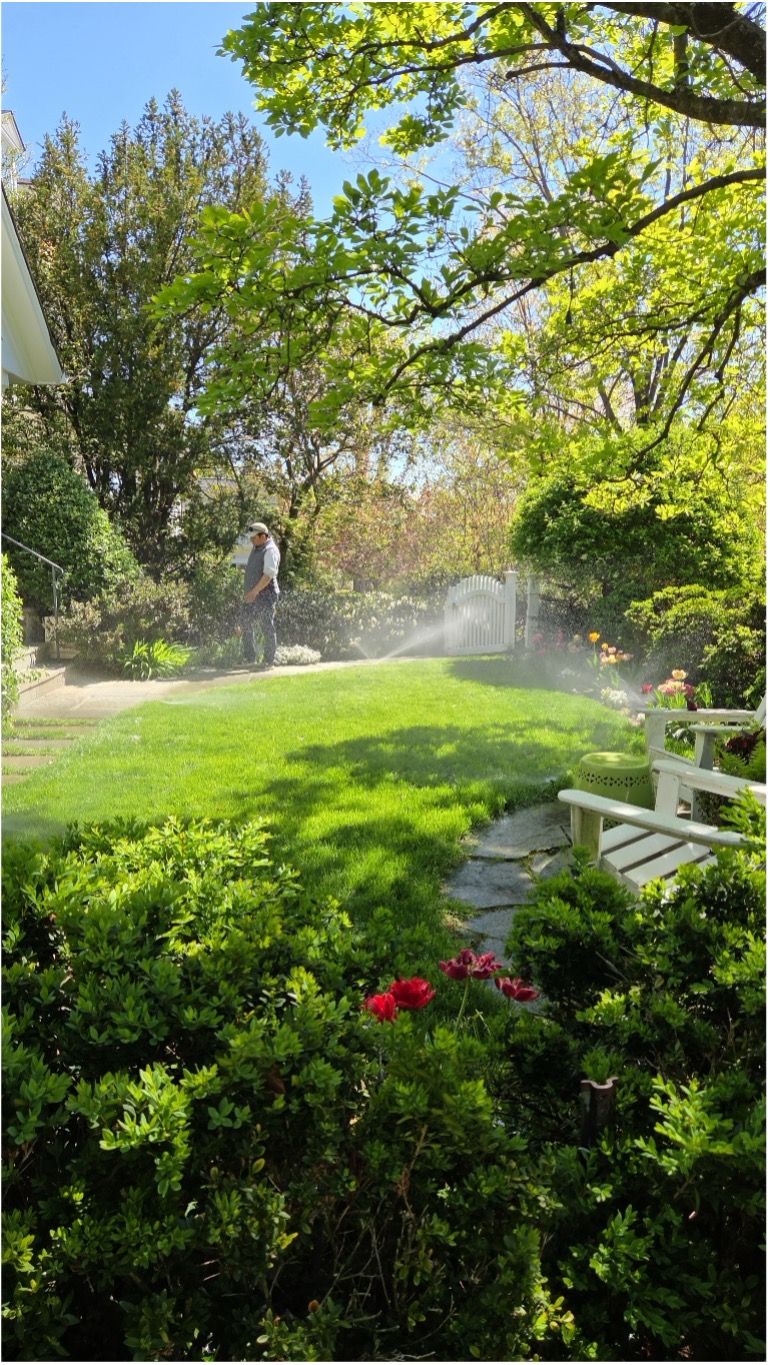
They typically consist of a control box, a series of valves leading to underground piping, sprinkler heads and drip lines laid out in zones, and a rain sensor. Different areas of the garden—lawn, beds, containers—can be managed separately.
A word of warning: watering systems are not “set it and forget it.”
They are great for establishing baseline watering, but they require consistent monitoring. There are always “watering shadows”—corners that don’t quite receive coverage, places where growth has blocked a sprinkler head, or spots the system just does not get to.
And these systems are, at the end of the day, electrical and mechanical. A tripped outlet, a faulty rain sensor, or a squirrel chewing through a drip line can quickly create problems.
I once worked on a roof garden made up entirely of large containers, all on a daily summer watering schedule—necessary to keep significant trees alive under those conditions. A storm knocked out power to the system, and no one checked for a week during a heat wave. The call I received was desperate. We lost years of growth in a matter of days. Removing and replacing trees on a roof is no small thing.
These systems also require seasonal maintenance in climates where the ground freezes: a fall visit to blow out the lines, and a spring visit to restart and inspect.
All of this adds up to a simple point—watering systems are just that: systems, not solutions.
They are incredibly valuable tools in growing great gardens, but they are not foolproof. They require attention, adjustment, and often some supplemental hand watering to truly do their job.
DIY / “Mini” Watering Systems
As an alternative to a professionally installed system, there are effective “mini systems” available.
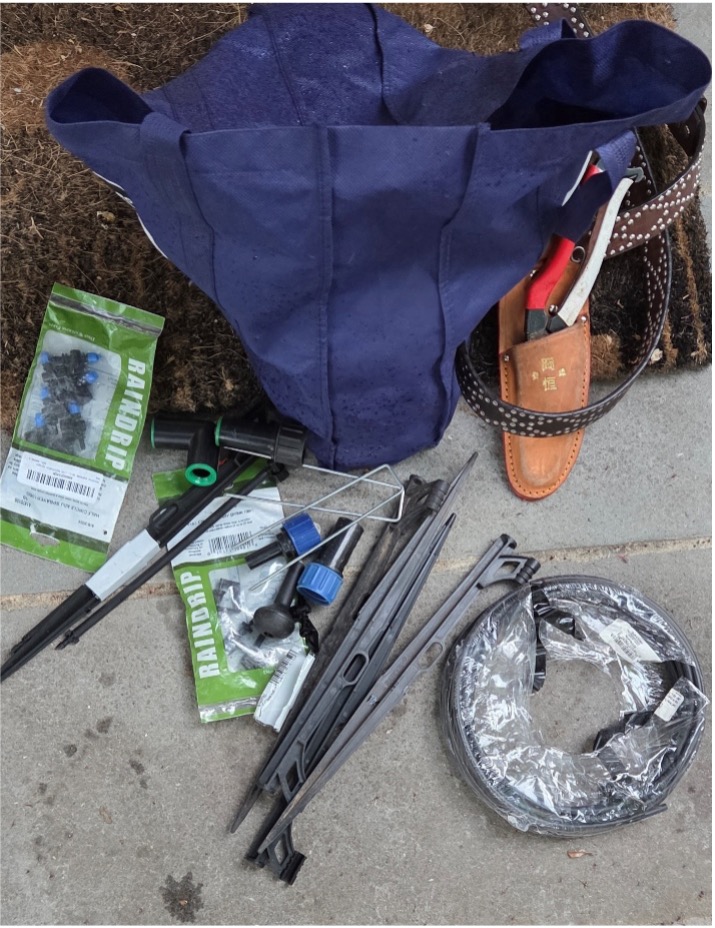
For the DIY-er, you can purchase the components, attach them to your outdoor spigot with a battery-operated timer, and put together a pretty reliable system at a reasonable cost—particularly for a smaller space.
This is what I use in my own garden, and in a number of my smaller projects.
You begin with a battery timer securely attached to the spigot—this is key, as the water supply is essentially open to this controller. From there, black poly tubing is run through the garden, staked in place, and capped at the end.
Different types of sprinkler heads can be punched into this line, attached with small feeder tubing. This allows you to fine-tune coverage as the garden grows and shifts.
You can add quite a few heads, but only up to a point—eventually you will outrun your water pressure. In my own roughly 25' × 50' garden, I can achieve fairly complete coverage with about six heads, along with a couple of lines dedicated to containers.
For the winter, the timer should come inside, but the rest can remain. If parts are damaged or wear out, they are easy and inexpensive to replace.
You could take the whole system up for winter—but in my experience, that rat is not worth the race.
I tend to tuck the sprinkler heads back and out of sight for the winter, then pull them up and reset them in the spring.
While not as robust or reliable as professionally installed irrigation, I like these systems for their flexibility, accessibility, and relatively low cost of maintenance.
Hand Watering
How to talk about hand watering?
For some, it is a chore. For others, a pleasure.
There is skill involved—sensitivity, attention, and patience—and having things set up, and what you need on hand, goes a long way.
I am, myself, not a great hand waterer. It requires a kind of sustained attention, and I am easily distracted. Still, I do my best—and I admire and value the people on my team, and around me, who are actually good at it.
I also don’t particularly like to get wet… and it is very easy to end up with wet shoes, wet socks, wet everything.
So—maybe best to start with the basics: equipment.
A good quality, traditional rubber garden hose—something that is easy to wrangle—is the best place to begin. I tend to use this kind of hose to get from the spigot to a central area I want to water from, and often leave the hose out to that point—tucked into the garden growth or along a bed edge for convenience. Constant rolling and unrolling of a hose is a headache. I will put it away if I am showing off the garden, but for everyday use, I don’t find a discreet hose in the garden to be offensive.
A hose-end stopper, kept constantly attached, saves you from having to sprint from spigot to hose end every time you turn the water on.
I favor a simple hose-end shutoff valve with a thumb lever. I buy inexpensive plastic ones by the dozen and keep one on the end of every hose. For watering, I think they are the best option—they provide excellent control and a clean water break, better than multi-setting spray nozzles.
And on that note—please avoid high-pressure spray nozzles. That kind of pressure will blow flowers and tender leaves clean off your plants.
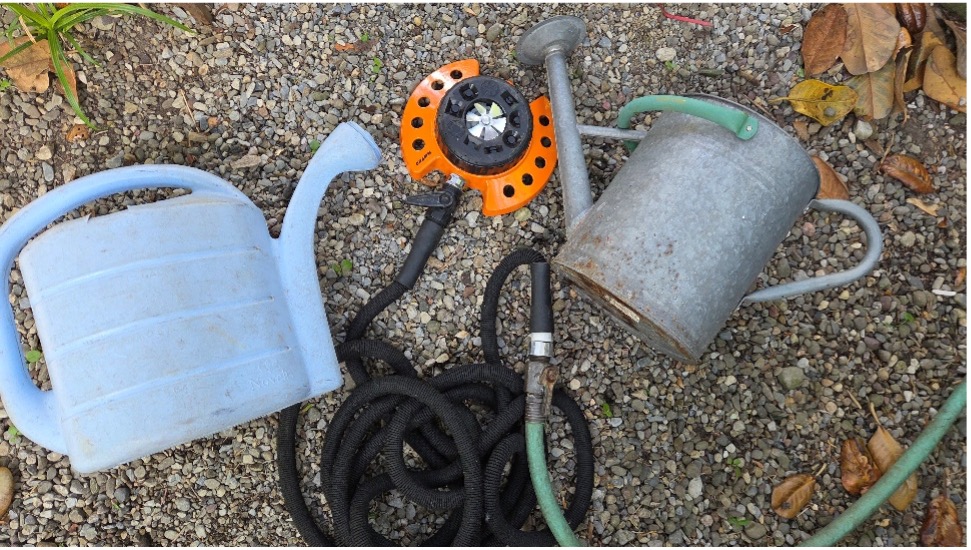
The second thing I like to have on hand is a collapsible “flexi hose.” These are great—they expand when filled with water and shrink down when empty.
They are not particularly durable. They can fail if left under pressure too long, or if punctured. A single rose thorn can rupture them. I don’t mind too much—I’m happy to replace them, because they are so light and easy to move through the garden.
A hose-end sprinkler is also valuable. It allows you to keep water going while working elsewhere. Paired with a shutoff valve, it gives you a surprising amount of control.
Finally—a watering can really carries its weight. Sometimes a can or two is enough—for containers or individual plants that need extra attention. I carry my chepo blue plastic can around in the back of my truck, but you can get all kinds – watering cans make great garden accessories, but in a pinch, a bucket also works!
With your equipment in place, a few thoughts on technique.
It’s hard to describe exactly how to water. It has to do with observing plants, knowing what they need, and watching soil conditions—how water is being taken up, and how it moves.
When I can force myself into that kind of attentive watering, I work in small sections—maybe six square feet at a time—addressing each plant individually.
Sometimes I even count, waiting until the soil is saturated and just beginning to lightly puddle before moving on.
It is a quiet, incremental process—one that asks you to slow down and pay attention. It also asks you to just do this one thing, and remain focused on it—something easier said than done (for me anyway!).
And in that way, hand watering can maybe become something different than a chore. It can become a way of being with the garden.
Between watering systems and hand watering, there is no clear hierarchy—only different ways of showing up. Systems give consistency and coverage. Hand watering asks for attention and presence.
The best gardens, in my experience, have some measure of both. A system may keep things alive—but it is the time spent with a hose in hand that tells you what is really going on.
Watering, in the end, is not only about delivering water. It is about staying in relationship with the garden as it moves through the season.